Fitted for
Almanac Hill,
State of Maine, U.S.
Elevation 920 feet
|
 N.B. The pages in this column are constantly under construction, being expanded frequently. Please check them occasionally for fresh content and additional links.
|

WEATHER PAGE
ASTRONOMY PAGE

TIME PAGE

REFERENCE PAGE
|
|
For an explanation of the terms used in the Observations column, please consult here.
Tuesday, October 28, 2025
Most of us imagine time as a line, pushing ever into the future. I'm not so sure.
I think it also moves in circles, bringing us back to a point in time where we were once, never can be again, and yet, here we are again.
Maybe time is like a spiral, that brings is back close to where we once were, but not exacly to the same place.
I get this fit of whimsy every October 28th, when we mark the anniversary of this almanac's first Observation post, in 2003. It began in a series of conversations between yours truly and a professional meteorologist in Bangor, Maine, about some boisterous weather we'd been observing that Autumn. I started recording some of those observations in this very forum, and the Almanac has changed very little in the past 22 years, except for the links.
Here we are, having returned in the planet's circles for more than two decades. I am living in a different locale, and have, sadly, lost track of my interlucutor. Same place, different place. The stars in tonight's sky are in the same places as they were on that night back then, but not exactly. We've all drifted a little since then.
As is traditional, here's the very first Observation.
October 28, 2003
The combination of astronomical high tide with run-off from recent heavy rains and the meltage of several inches of snowfall in the north brought the Kenduskeag Stream and Penobscot River to unusually high levels at the noon high tide.
The river had slopped over its banks on the Brewer side near the Muddy Rudder Restaurant and on the Bangor side near the Estevan Gomez monument.
The Kenduskeag had risen to the footbridge near Bangor Savings Bank, such that one could not have swum under it with much of one's head above water level. The high water mark in the canal was at the bevel on the ledge which is just a yard or so below the railing, and at some points along the river walk had just slightly exceeded it.
We noted at the evening low tide that the stream was gushing past the Central Building on Central Street and that the river was still unusually high, as could be observed from the Chamberlain Bridge. It was a "late September day," as the high reached into the lower 60s under mostly sunny skies. We are trying to adjust to the early darkfall, in these first days of Eastern Standard Time. (CQ)
Yours truly,
Colby Quid
Wednesday, October 22, 2025
A longstanding tradition at this Almanac is to republish every year at this time an essay that ran in the Maine Times many years ago, that has long been a favorite of your editor. It needs no introduction, so we let it speak for itself.
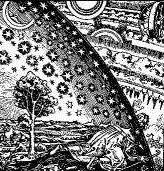
The Woods Are Full Of Star Maps
By Dean Schneider,
Lewiston, Maine
First Published in Maine Times
Friday, October 22, 1982.
After filling the bird feeder one morning this autumn, I was saddened to find a small dead bird - a warbler - lying in the grass under our picture window. Perhaps it had mistaken the reflection of sky and trees in the glass for the real thing.
I didn't recognize her species, so I assumed her to be an immature female that was just beginning her first migration. I smoothed the feathers on the little head. Her brain was smaller than a pea, yet it contained all the information necessary to be a proper warbler: how to fly, find food, and reproduce.
Next spring she could have built her first nest without her mother or any other bird showing her how, and she would have made it just right. It is as though she would have taken a little manual entitled "How to Build a Nest" out of a cubby-hole in her tiny brain, then opened its brand-new pages to Step One, which begins, "Select a piece of dead grass about two inches long..."
But this bird was so young that she hadn't even discovered a lot of the "how-to manuals" in her brain. One rather lengthy instruction booklet would have been "How to Migrate from Maine to Venezuela in the Fall." With it would be a compass, a clock, and even star maps. Most small birds migrate at night, and from experiments with birds released in planetariums, biologists have found that birds do actually use certain stars to guide them on their migration. This means that a way of keeping time is needed because the stars rotate through the sky just as the sun does.
Birds also seem to be sensitive to the earth's magnetic field. Biologists discovered this by placing tiny magnets on the heads of homing pigeons. While wearing the magnets, the pigeons could not return home as well. It would be similar to my trying to use a compass while I had a magnet in my pocket. The compass would point to the magnet, rather than the North Pole.
From experiments like these, it now seems that many birds use a combination of landscape features, magnetism, and the stars when they migrate long distances.
I would need weeks to learn to navigate by air to Venezuela, if I ever could (My trigonometry is very weak.), but this little bird was hatched knowing how. And all that information was packed into a bit of brain tissue too small to see.
So I had in my hand that autumn morning a complete set of star maps on how to get to Venezuela, all neatly packaged in a tuft of colorful feathers. I felt a lingering melancholia about them fading away, unused. My only consolation was that on this incredible, profligate planet, the woods are full of star maps.
Yours truly,
Colby Quid
Tuesday, October 14, 2025
It's easy to think of the turnings of the seasons as cycles of beginnings and endings. Spring is obvously a beginning, Autumn an ending, and between them lie Summer's revels and Winter's rests.
And, as a lifelong resident of northern New England, I am inclined to assent to this view, at least intellectually. But there's something about Autumn that calls to mind Eliot's admonition that April is the cruelest month, because of its “breeding lilacs out of the dead land” and “stirring dull roots with spring rain.” These vernal awakenings in nature are a call to action. Summer's light comes over the horizon, and if one is not to be brought up short, one had better get up and get going. Yet, something there is that gets comfy with Winter's torpor, and April's call has a cruel tone.
And something there is in me that goes the other way in Autumn, something that greets the first chilly nights and crisp days since last Spring as the warning they are: Winter's shadow comes over the horizon, and if one is not going to be brought up short, one had better shake off Summer's lazy habits and get moving.
This Almanac has been on a long Summer vacation, for the better part of two years, while your editor has been tending to a long season of life transition. But, with hoarfrost greeting me a couple of mornings last week, and with commitments from the transition winding down like so many crisp and colorful leaves, I blew the dust off the covers, corrected some broken links, and stirred this Almanac out of the long Summer's languidity.
And thus, beginnings are endings, and endings are beginnings.
Yours truly,
Colby Quid
|
|
|